
A clinic spends £600 a month on Google Ads, gets 300 clicks, and books 11 patients. The owner concludes that Google Ads don’t work for clinics.
The ads did their job. They put 300 interested people in front of the clinic at roughly £2 each. The website sent 96 out of every 100 of them away again.
A page that converts badly costs you twice over. You pay for the click whether the visitor books or not, so every one you lose raises the price of the patients you win. Google then judges you on the same page, because landing page experience is one of 3 components in its ad quality score, alongside ad relevance and expected click-through rate.
The gap between clinics is wider than most owners assume. Unbounce studied 41,000 landing pages and found professional and commercial services convert at a median of 6.1%, with the top quarter reaching 14.1% or better. On identical ad spend, a clinic at the median pays about twice as much for each booked patient as one in the top quarter.
1. Send the click to a page about the thing you advertised
The most expensive habit in clinic advertising is pointing every ad at the homepage. A homepage introduces the clinic, lists every service, covers opening hours, and speaks to everyone from a curious neighbour to a returning patient. Your advert has already narrowed that down to one person with one problem.
Someone who clicked an ad about knee pain should land on a page about knee pain, using the words the ad used. When the headline repeats the promise, the visitor stops checking whether they’re in the right place and starts reading about their knee.
Why it works: Matching the page to the ad answers the visitor’s first question, which is whether you treat what’s wrong with them.
2. Make the page load before they give up
Google trained a neural network on real bounce and conversion data and found that as load time climbs from 1 second to 10, the probability of a mobile visitor bouncing rises by 123%. The same analysis found that as the number of elements on a page grows from 400 to 6,000, the probability of converting falls by 95%. Google named healthcare as one of the sectors with the most room to improve.
Those elements are the things clinics add without thinking about the cost. Image sliders, embedded maps, chat widgets, review carousels, tracking scripts, and photos uploaded straight from a phone at four megabytes each. Every one is another request a phone has to finish before the page becomes usable.
Why it works: You have already paid for the click by the time the page starts loading. Speed decides whether you get anything back for it.
3. Take away everything that isn’t the booking
On an ordinary website, links help people explore. On a page you are paying to send people to, every link that isn’t the booking is a way out.
Cut the navigation menu, the social icons, the related articles, and the link to your careers page. Leave one offer and one action. This matters most on a phone, where 83% of landing page visits happen and a mistaken tap means starting over.
Why it works: A visitor who can only do one thing on the page is far more likely to do it.
4. Write it the way you would say it
Clinics write about themselves in a professional register because it feels appropriate. Unbounce found that pages written at a 5th to 7th grade reading level convert at 11.1%, which is 56% better than pages pitched 2 grades higher.
Your patients are not slow. They are in pain, holding a phone, and skimming. “Physiotherapy for musculoskeletal dysfunction” asks them to translate before they can tell whether you help with a bad back. “Help with back pain” doesn’t. Use the words a patient would use describing the problem to a friend.
Why it works: Plain words let a skimming visitor confirm they’re in the right place without stopping to work it out.
5. Put the proof beside the button
A visitor who arrived from an advert has no history with you. They found the clinic less than a minute ago and are deciding whether to hand over their back, their neck, and their card details.
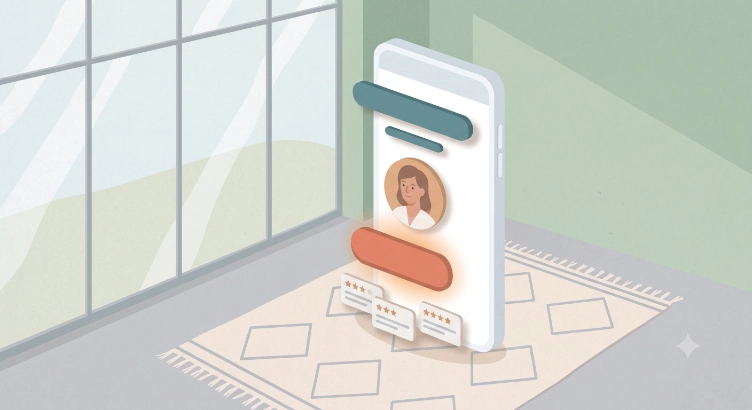
Put the reasons to trust you where that decision happens. That means named reviews with star ratings, your registration with the HCPC, GOsC or GCC, a photo of the practitioner who will actually treat them, and the price. Proof sitting at the bottom of the page only reaches the people who had already made up their minds to scroll. We covered how to use your reviews properly here.
Why it works: Hesitation peaks at the button, so that is where the evidence needs to be.
Fix the page before you touch the budget
Raising a clinic page from 4% to 12% triples the bookings from the same spend, and it keeps working on every click you buy afterwards. Ad budgets are the expensive thing to change. The page is the cheap one.